
Why Is My Dishwasher Not Draining? Causes, Fixes, and Troubleshooting Guide
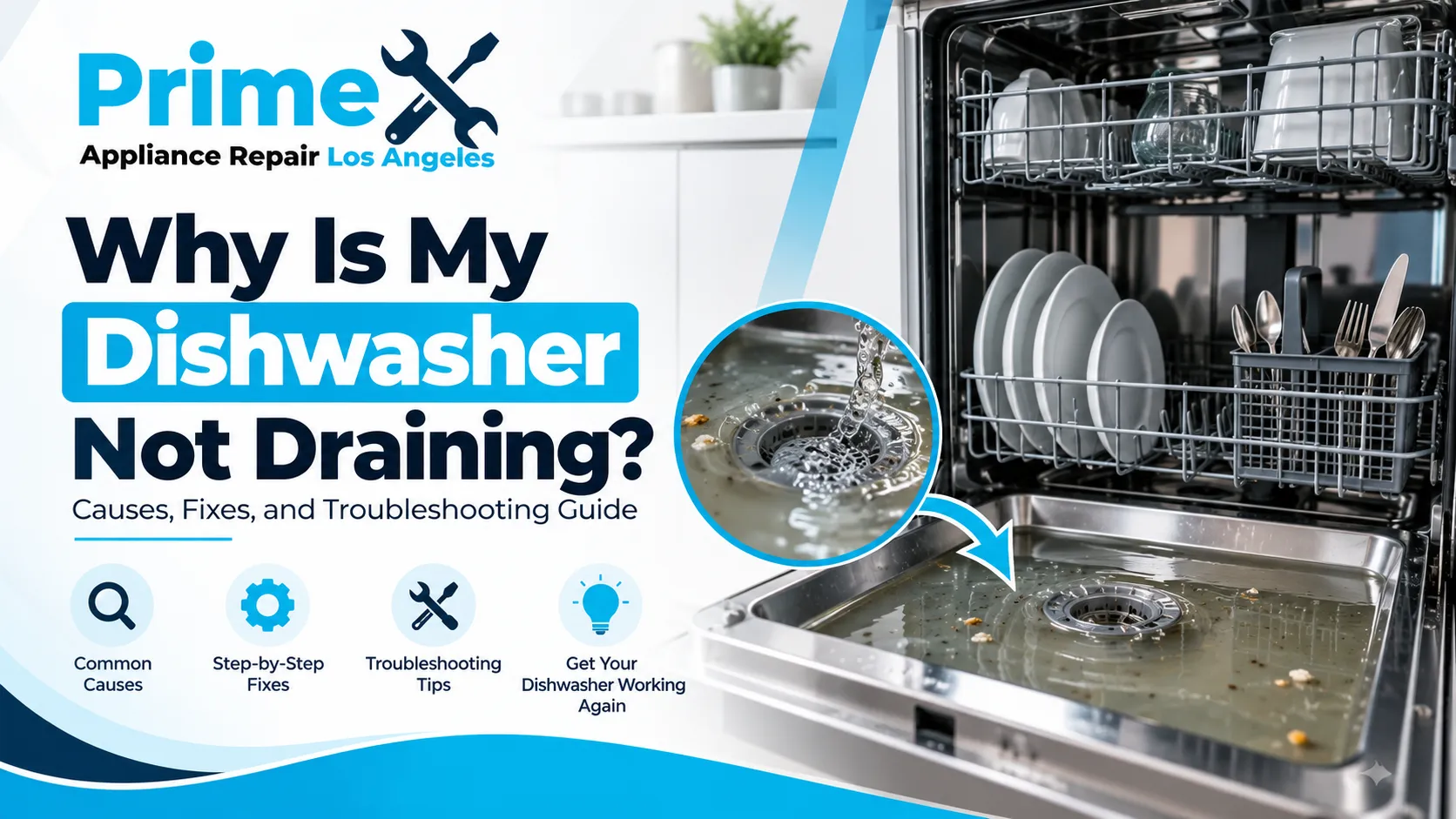
If you are asking, “Why is my dishwasher not draining?”, the problem is usually somewhere along the path that carries dirty water out of the appliance. A clogged filter, food debris in the sump, a kinked drain hose, a blocked air gap, a garbage disposal problem, or a faulty drain pump can all leave water sitting at the bottom of the dishwasher.
The good news is that many drainage problems are easier to diagnose than they first appear. You can often narrow down the cause by checking the dishwasher in a simple order, starting with the filter and sink connection before moving to the drain pump.
For homeowners in Los Angeles, it is also worth checking the air gap, garbage disposal, and under-sink plumbing. These parts can affect drainage even when the dishwasher itself is working correctly.
This guide explains what causes a dishwasher not to drain, what you can safely check yourself, and when the problem may need professional diagnosis.
Dishwasher Still Not Draining?
If standing water keeps coming back after basic checks, a professional inspection can help find the real drainage problem.
Quick Answer: Why Is My Dishwasher Not Draining?
A dishwasher may stop draining because water cannot move freely from the tub to the household drain. The most common causes include:
- A dirty or clogged dishwasher filter
- Food or debris inside the sump
- A kinked or blocked drain hose
- A clogged air gap
- A blocked garbage disposal connection
- A garbage disposal knockout plug that was never removed
- Too many soap suds
- A jammed or damaged dishwasher drain pump
- An interrupted wash cycle
- A control, wiring, or electrical problem
Whirlpool also identifies filters, drain hoses, garbage disposals, air gaps, and drain-pump restrictions as common places to check when a dishwasher does not drain.
What Does Standing Water in a Dishwasher Mean?
Not every small amount of water means something is broken. Some dishwashers keep a little water around the filter or sump area. This can help keep seals from drying out. Whirlpool, for example, notes that a small amount of water in the filter area can be normal on some models.
The situation is more concerning when you see a visible pool of dirty water covering the bottom of the dishwasher after the cycle has finished. Watch the amount and location of the water.
What You Notice | Possible Cause | First Thing to Check |
Small amount near the filter | May be normal | Check the owner’s manual |
Water covering the tub bottom | Drain restriction | Filter and sump |
Dishwasher hums but does not drain | Pump obstruction or blocked hose | Sump, hose and pump |
Water comes from the air gap | Downstream blockage | Air gap and drain hose |
Dishwasher is silent during drain | Pump or electrical issue | Drain cycle and controls |
Problem started after new disposal installation | Knockout plug may remain | Disposal dishwasher inlet |
Sink also drains slowly | Household plumbing restriction | Sink drain and disposal |
Dishwasher drains, then water returns | Backflow or drain-hose routing problem | Air gap or high loop |
How Do You Fix a Dishwasher That Is Not Draining?
Start with simple checks. Do not replace the drain pump until you know that water has a clear path out of the dishwasher.
1. Make Sure the Cycle Actually Finished
Sometimes the dishwasher is not broken at all. Opening the door during a wash, losing power, or pressing the wrong control can interrupt the cycle before the final drain. Close the door fully and check the control panel. Many dishwashers have a Cancel/Drain function rather than a separate dishwasher drain button.
On some Whirlpool models, pressing Cancel/Drain and closing the door starts a drain cycle that runs for about two minutes when water is present. Controls vary by model, so check your owner’s manual before assuming the same button sequence applies to every dishwasher.
If the dishwasher drains normally after this step, the earlier cycle may simply have been interrupted.
2. Remove Excess Standing Water
If there is a large amount of water inside, remove most of it before working around the filter. Switch off power to the dishwasher before putting your hands near the sump or pump area. Use a cup, sponge, turkey baster, or small hand pump to remove the standing water. Place towels nearby in case water spills.
This makes it easier to see debris around the filter and sump. Do not reach blindly into the bottom of the dishwasher. Small pieces of broken glass can sometimes collect near the filter or pump.
3. Clean the Dishwasher Filter
A dirty filter is one of the first things worth checking. Remove the lower dish rack and locate the filter near the bottom spray arm. The exact design varies by brand. Take the filter out according to the manufacturer’s instructions and rinse it under warm running water. A soft brush can help remove grease and food residue.
Then inspect the area underneath it. Look for pieces of food, labels, seeds, bones, broken glass, toothpicks, or other debris that may restrict water flow.
Whirlpool specifically recommends cleaning the filter and checking the sump when investigating a dishwasher that will not drain. After cleaning everything, reinstall the filter correctly. A filter that is not properly seated can also create problems.
Why Is My Dishwasher Not Draining but There Is No Blockage?
A dishwasher can fail to drain even when you cannot see a blockage. The problem may be deeper in the drain system.
For example, the hose might be partially restricted where you cannot see it. The drain pump impeller may be jammed. The sink connection may be blocked. The drain hose may be installed incorrectly. There may also be an electrical or control problem preventing the pump from operating correctly.
Another possibility is backflow. The dishwasher may actually pump the water out, but some water can return afterward if the drain hose or air-gap system is not working as intended. If the filter and visible drain area are completely clean, move your troubleshooting toward the hose, air gap, garbage disposal, and drain pump.
Check the Garbage Disposal
If your dishwasher drains through a garbage disposal, the disposal can affect dishwasher drainage. Run the disposal briefly and make sure the sink itself drains normally. A particularly important problem occurs after installing or replacing a garbage disposal.
New disposals often have a knockout plug inside the dishwasher connection. That plug must be removed before the dishwasher can drain through the disposal. If it remains in place, the dishwasher may run normally but have nowhere to send the wastewater.
Whirlpool specifically recommends checking the disposal knockout plug when a newly installed dishwasher does not drain. If your drainage problem started immediately after a new disposal was installed, this should be one of your first checks.
Check the Dishwasher Air Gap
Some dishwasher installations have a small air-gap fitting mounted near the kitchen faucet. Its job is related to preventing dirty drain water from flowing back toward the dishwasher. If debris builds up inside the air gap, drainage can slow down or stop.
Remove the air-gap cover if its design allows it and inspect the inside for food or buildup. Water coming out of the air gap while the dishwasher drains can also point toward a blockage farther downstream between the air gap and the sink or garbage disposal. After cleaning it, run another drain cycle and see if water leaves normally.
Check the Dishwasher Drain Hose
The dishwasher drain hose carries wastewater from the dishwasher to the household plumbing. Follow the hose under the sink as far as you can see. Check whether it is:
- Kinked
- Pinched
- Crushed
- Twisted
- Clogged
- Poorly routed
A kink can reduce flow enough to leave water inside even when the dishwasher drain pump is running. Whirlpool recommends checking for a kinked, pinched, or clogged hose when diagnosing long-drain conditions.
How to Clean a Dishwasher Drain Hose Without Removing It
People often search for how to clean a dishwasher drain hose without removing it, but a true internal hose blockage may eventually require disconnecting at least one end. Before doing that, however, there are several checks you can make without removing the entire hose from the dishwasher.
First, straighten any visible kink. Next, clean the air gap if your installation has one. If the dishwasher connects to a garbage disposal, make sure the disposal and its inlet are clear. You can also clean the dishwasher filter and sump because material trapped there may be preventing water from ever reaching the hose properly.
Avoid pushing sharp metal objects deep into the hose. They can puncture it and create a hidden leak. If these steps do not restore drainage, the sink end of the hose may need to be disconnected and inspected or flushed.
Dishwasher Not Draining but Pump Running: What Does It Mean?
A dishwasher not draining but pump running gives you an important diagnostic clue. If you hear the drain pump humming or running, the dishwasher is at least attempting to remove the water. The problem may instead be:
- Debris around the pump impeller
- A blocked drain hose
- A clogged air gap
- A restricted garbage disposal connection
- A damaged pump impeller
- A partially failed drain pump
Whirlpool notes that steady humming without water movement can indicate a jammed impeller or obstruction around the pump area. Do not assume that hearing the pump means the pump is healthy. A motor can run while the impeller fails to move enough water.
If the filter, sump, hose, disposal, and air gap are clear but the dishwasher still only hums, the drain pump may need closer inspection.
What Does the Dishwasher Drain Pump Do?
The dishwasher drain pump removes dirty water from the tub. During the drain part of a cycle, the control board sends power to the pump. The pump then pushes water through the drain hose toward the sink plumbing or garbage disposal.
Drain pumps contain moving parts. Food fragments, small glass pieces, labels, and other debris can interfere with the impeller. A failed pump can produce several symptoms. You may hear a hum but see no water movement. The pump may make unusual grinding sounds. In other cases, you may hear nothing when the dishwasher should be draining.
Electrical testing or pump replacement involves more risk than cleaning a filter. If you are not comfortable working with appliance wiring or removing access panels, this is a good point to call an appliance repair technician.
Why Is My Whirlpool Dishwasher Not Draining?
A Whirlpool dishwasher not draining can have many of the same causes as other dishwasher brands. Whirlpool’s troubleshooting guidance recommends checking the filter, drain hose, garbage disposal connection, air gap, and drain system before assuming a major component has failed.
Some Whirlpool models may show an F9E1 error when the dishwasher detects a long-drain condition. Whirlpool lists a kinked hose, clogged filter, disposal issue, air-gap restriction, or other drainage obstruction among the items to inspect.
Whirlpool Dishwasher Not Draining but No Blockage
If you have a Whirlpool dishwasher not draining but no blockage is visible, first make sure the wash cycle actually completed. Then try the model’s Cancel/Drain function.
If the issue remains, Whirlpool also suggests cycling power to the dishwasher for some control-related problems. Current Whirlpool guidance says to cancel the cycle, disconnect power for at least one minute, restore power, and test the dishwasher again.
If the pump runs but water stays inside after all accessible drain paths are clear, a pump, control, wiring, or internal component problem becomes more likely.
Can Too Much Detergent Stop a Dishwasher From Draining?
Yes. Excessive foam can sometimes interfere with dishwasher operation. This commonly happens when regular liquid hand dish soap is accidentally placed in a dishwasher. Dishwasher detergent is designed to produce much less foam.
GE notes that the wrong detergent or excessive detergent can create oversudsing and contribute to drainage problems. If the dishwasher is full of suds, stop the cycle rather than adding more cleaning products. Once the foam is controlled, run the appropriate rinse or drain process recommended for your model.
What Can I Pour Down My Dishwasher to Unclog It?
Avoid pouring chemical drain opener into a dishwasher. Products designed for sink or sewer clogs can contain highly caustic chemicals that may damage dishwasher hoses, seals, pumps, and other components. GE specifically states that chemical drain cleaners should not be used in a dishwasher because they can damage rubber parts.
Instead of trying to dissolve the clog chemically, locate the restriction. Clean the filter and sump first. Then inspect the air gap, disposal connection, and drain hose. This approach addresses the actual cause without exposing appliance parts to aggressive chemicals.
How Do You Force a Dishwasher to Drain?
There is no universal dishwasher drain button for every make and model. Many machines use a button labeled Cancel, Cancel/Drain, or something similar. For example, certain Whirlpool models start a drain process after Cancel/Drain is pressed and the door is closed.
Check the control labels and owner’s manual for your exact model. Do not try to “force” drainage by bypassing door switches, applying power directly to the pump, or altering wiring. Those methods can create electrical and water-leak risks.
How Can You Tell Whether the Dishwasher or Plumbing Is the Problem?
This distinction can save time, especially in Los Angeles homes where the dishwasher may share drainage components with the kitchen sink or garbage disposal. If the kitchen sink and dishwasher are both draining slowly, the problem may be farther down the household drain system.
If the sink drains perfectly but only the dishwasher holds water, the problem is more likely within the dishwasher drain path or its connection to the sink. If water comes out of the air gap, inspect the downstream hose and sink connection.
If the pump never starts, the issue may involve the dishwasher rather than the household drain. When several plumbing fixtures are backing up at the same time, an appliance repair alone may not solve the problem.
When Should You Call for Dishwasher Repair in Los Angeles?
Basic cleaning can solve many dishwasher drainage problems. However, there is a point where further DIY work may cause more harm than good. Consider professional diagnosis when the dishwasher still will not drain after the filter, sump, air gap, garbage disposal, and hose have been checked.
Service may also be appropriate when you notice leaking water, repeated electrical trips, burning smells, damaged wiring, unusual pump noises, recurring error codes, or a drain pump that is receiving power but cannot move water.
A technician can test the pump, wiring, control system, sensors, and related components without guessing which part needs replacement.
How Can You Prevent Future Dishwasher Drain Problems?
A few basic habits can reduce the chance of another drainage problem. Scrape large food pieces from dishes before loading them. Clean the dishwasher filter at the interval recommended by the manufacturer. Check the air gap occasionally if you have one. Keep the garbage disposal clear, and do not allow objects under the sink to crush or move the drain hose.
Also use detergent made specifically for automatic dishwashers. These small maintenance steps can reduce grease, food debris, and other material reaching the drain system.
Need Fast Dishwasher Repair in Los Angeles?
Get help with drain pump issues, clogged drain lines, standing water, and other common dishwasher problems.
Frequently Asked Questions
Why is there standing water at the bottom of my dishwasher?
A small amount of water near the sump or filter may be normal on some dishwashers. A larger pool covering the bottom usually means the machine did not drain completely. Check the filter, sump, drain hose, air gap, garbage disposal connection, and drain pump.
How do you force your dishwasher to drain?
Use the dishwasher’s normal drain function rather than bypassing any safety system. Depending on the model, this may be labeled Cancel, Drain, or Cancel/Drain. Check the owner’s manual for the correct button sequence.
How do I know if my dishwasher drain hose is clogged?
A clogged hose may cause standing water even while the drain pump is running. You may also hear humming, notice slow drainage, or see water backing up through the air gap. Inspect the visible hose for kinks first, then check the hose connection for debris.
What can I pour down my dishwasher to unclog it?
Do not pour chemical drain cleaner into a dishwasher. These products can damage appliance components. Instead, clean the filter and sump and inspect the drain hose, air gap, garbage disposal, and sink connection.
What should I do if water won’t drain from the dishwasher?
Cancel the cycle and try the normal drain function. If water remains, turn off power before inspecting the filter and sump. Then check the garbage disposal, air gap, drain hose, and sink connection. If everything is clear but the dishwasher still will not drain, the pump or electrical system may need professional testing.
Can I run my dishwasher if there is standing water?
A very small amount of water in the sump may be normal, depending on the model. However, you should not continue running normal wash cycles when a large amount of dirty water remains across the bottom. Find the drainage problem first because repeated cycles can lead to poor cleaning, odors, backups, or leaks.
Conclusion
If you are wondering why your dishwasher is not draining, start with the simple parts before assuming the dishwasher needs an expensive repair.
Make sure the cycle has finished. Clean the filter and sump. Check the garbage disposal and air gap. Inspect the drain hose for kinks or restrictions. Then listen to what the dishwasher drain pump does when you start a drain cycle.
A pump that runs without moving water often points toward a restriction or pump problem. A pump that never runs may indicate an electrical, control, or component issue. For a Whirlpool dishwasher not draining, the same basic process applies, with special attention to the filter, hose, disposal connection, air gap, and any drain-related error codes.
Most importantly, avoid pouring chemical drain cleaner into the machine or bypassing its electrical safety systems. A careful step-by-step check can often reveal whether the problem is simple maintenance, a plumbing restriction, or a dishwasher component that needs professional repair.