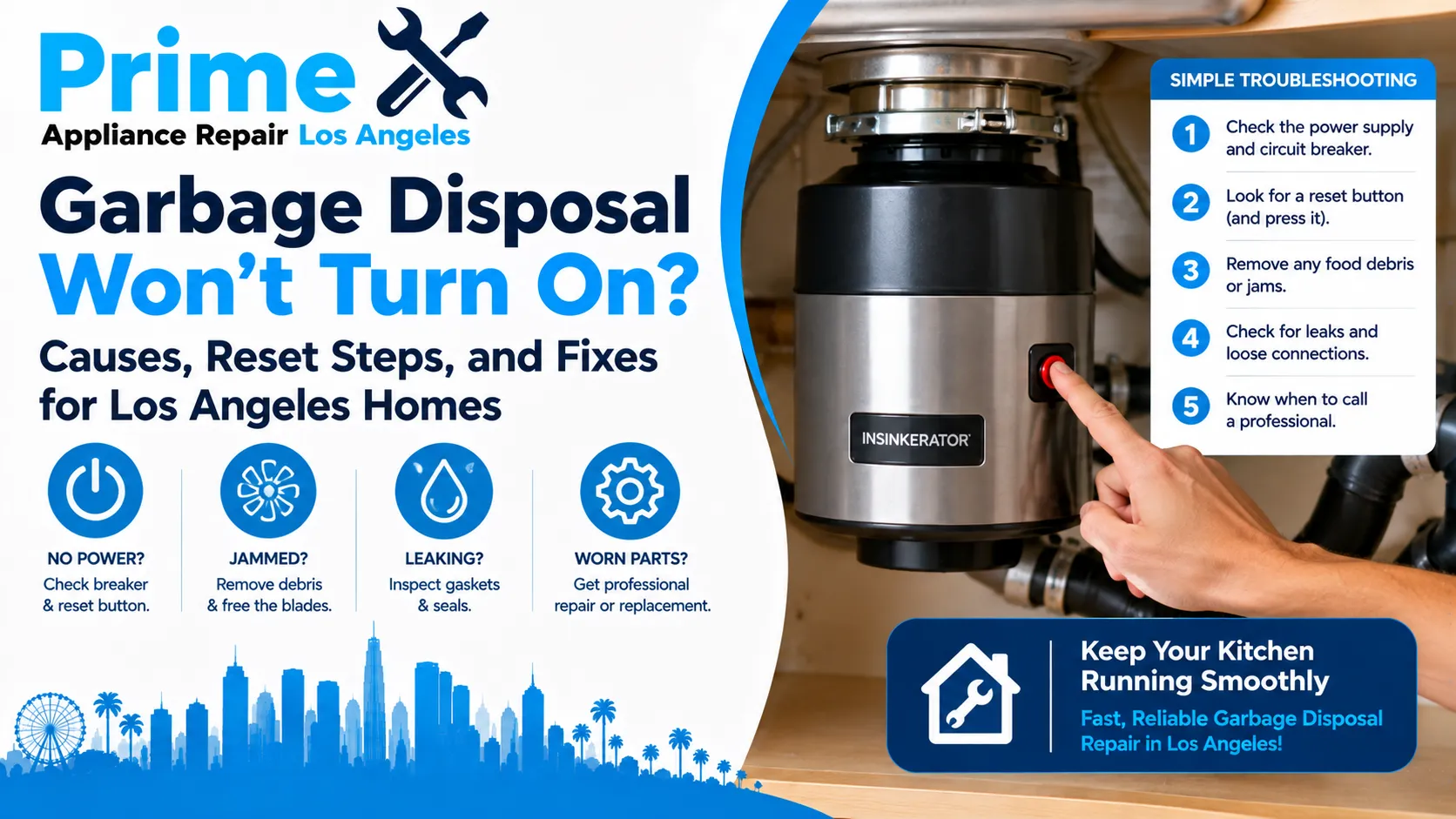

Garbage Disposal Won’t Turn On? Causes, Reset Steps, and Fixes for Los Angeles Homes

Why Won’t My Garbage Disposal Turn On?
The most common causes are a tripped reset button, a tripped circuit breaker, a disconnected power source, a jam inside the grinding chamber, a faulty wall or air switch, damaged wiring, or a failed motor.
The first step is to determine what happens when you activate the switch. If you hear absolutely nothing, start with the power supply. If you hear humming, stop repeatedly activating the disposal because the grinding components may be jammed.
Manufacturers also recommend disconnecting power before attempting to remove an obstruction and avoiding putting your hands inside the disposal. Long-handled tongs or pliers are safer for removing visible foreign objects.
Quick Diagnosis: What Does Your Garbage Disposal Symptom Mean?
Symptom | Possible Cause | First Thing to Check |
Disposal is completely silent | No power, tripped reset, breaker, switch problem | Outlet, breaker, reset button |
Disposal hums but does not grind | Jammed turntable or foreign object | Disconnect power and check for obstruction |
Reset button keeps popping out | Persistent jam, overload, or internal problem | Clear jam and allow motor to cool |
Disposal has power but won’t run | Jam, motor problem, faulty switch | Reset and inspect for obstruction |
Disposal stopped after glass entered | Glass may be locking internal movement | Disconnect power and carefully remove visible pieces |
Disposal runs but won’t turn off | Wall switch, air switch, or electrical fault | Shut off power at breaker |
Disposal won’t work after reset | Jam, electrical failure, or damaged motor | Check power and internal movement |
This symptom-first approach can prevent unnecessary disassembly. It also helps you decide whether the problem belongs to the disposal itself or the electrical supply feeding it.
How Do You Reset a Garbage Disposal?
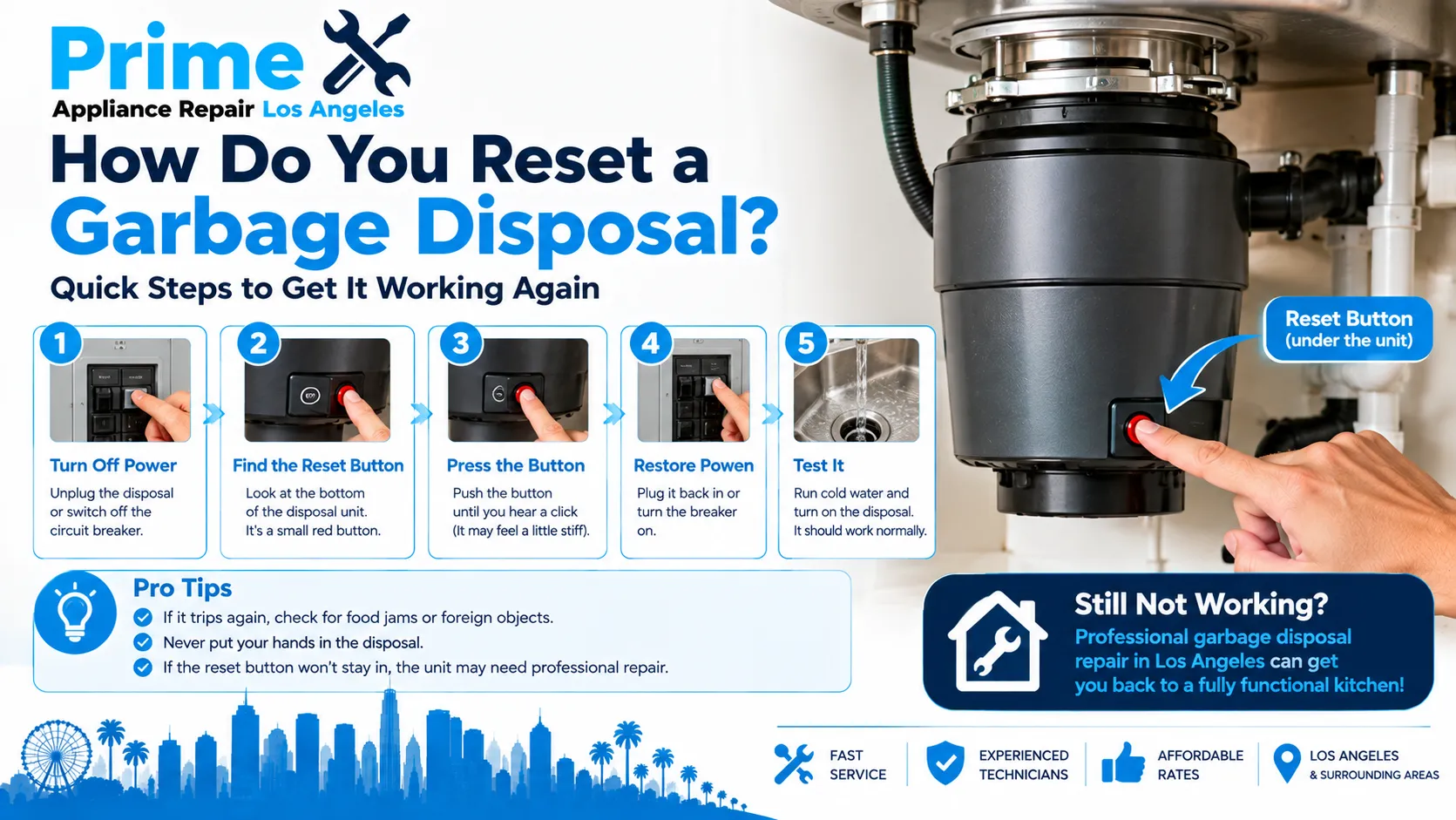
A garbage disposal reset is often the simplest fix when the unit suddenly stops working. Many disposals contain an internal overload protector. If the motor overheats or struggles against a jam, this protector can interrupt power to prevent further damage. The garbage disposal reset button usually appears as a small red button near the bottom or lower side of the unit.
Moen, for example, describes its reset button as the control used to reset the disposal’s internal breaker. To reset a typical disposal:
- Turn the disposal switch off. If you plan to inspect inside the chamber, unplug the unit or shut off its circuit breaker. Let an overheated unit cool for several minutes. Locate the reset button underneath or near the bottom of the disposal, then press it firmly. Restore power and briefly test the disposal with water running.
- If it immediately hums, stops again, or the button pops back out, do not continue pressing the switch. The unit may still be jammed or may have another mechanical or electrical problem.
Never treat repeated resetting as the repair itself. The reset protects the motor; it does not remove whatever caused the overload.
Why Won’t My Garbage Disposal Turn On After Reset?
If your garbage disposal won’t turn on after reset, the reset button may not be the real problem. Check whether the outlet under the sink has power. Some disposals plug into a receptacle while others are hardwired. If yours is plugged in, you can test the receptacle with another small electrical device if it is safe to do so.
Manufacturer troubleshooting guidance recommends checking the outlet, household breaker, reset button, and possible jam when a disposal has no power. Also look at your electrical panel. A tripped circuit breaker may appear slightly out of position rather than completely off.
If the breaker repeatedly trips after being reset, stop troubleshooting the unit. Repeated breaker trips can point to an electrical defect, damaged wiring, or a failing appliance and should be assessed by a qualified professional.
Garbage Disposal Not Working but Has Power: What Does It Mean?
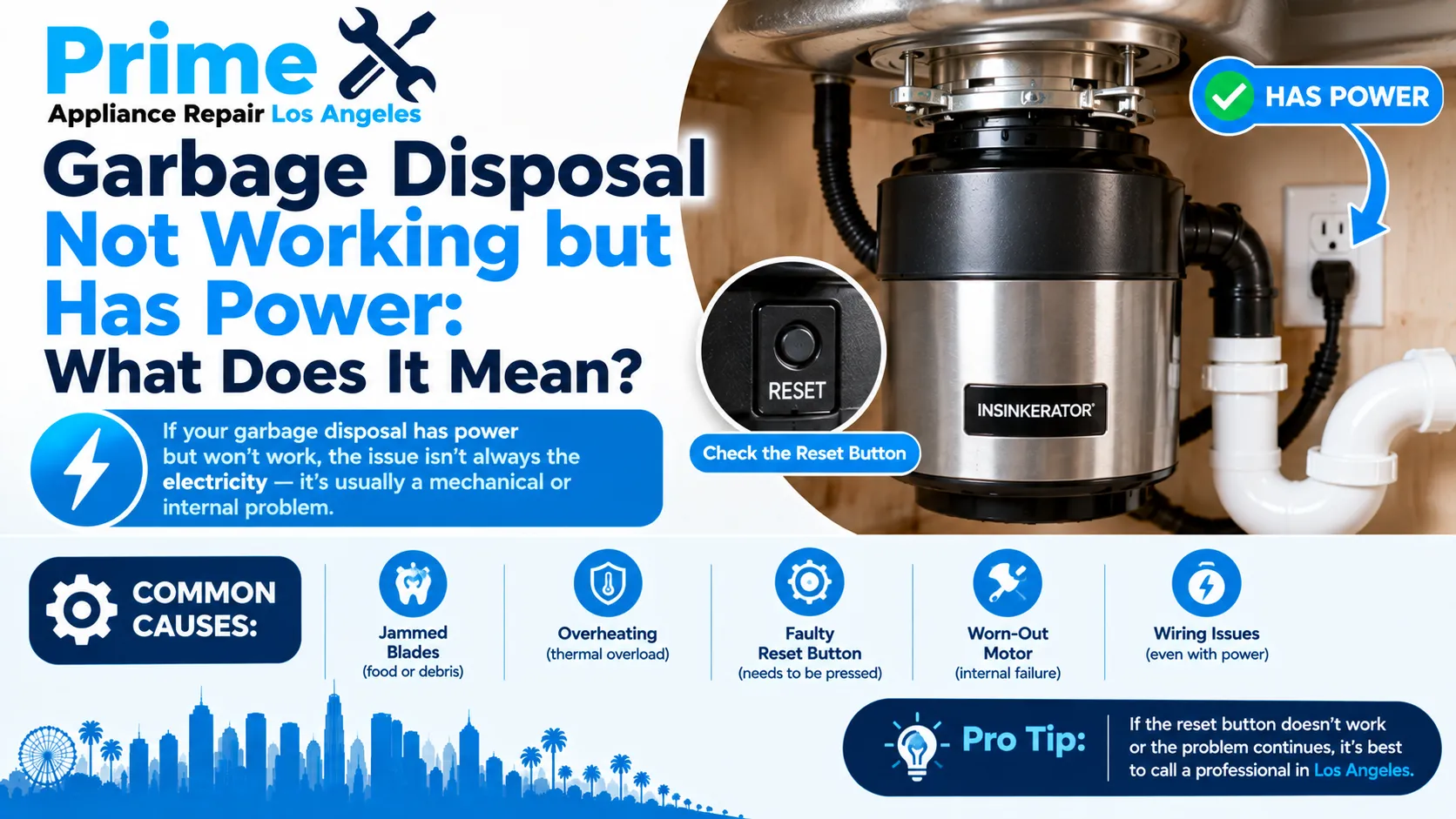
A garbage disposal not working but has power usually narrows the problem to the disposal, switch system, or internal mechanism.
For example, the outlet may test correctly, but the disposal remains silent. Possible causes include a failed switch, loose electrical connection, internal thermal protection, or motor failure. If the disposal hums instead of remaining silent, a jam is much more likely.
Do not assume that electrical power means the motor is healthy. A motor can receive voltage but still be unable to rotate because something is blocking the turntable or because internal components have failed.
Why Is My Garbage Disposal Humming but Not Working?
A garbage disposal humming but not working usually means electricity is reaching the motor, but the rotating mechanism is stuck.
Food waste, bones, utensils, glass, or other objects can prevent the turntable from moving. Manufacturer troubleshooting documentation specifically notes that lodged objects can prevent rotation and cause the motor to hum.
Turn the disposal off immediately if it hums without grinding. Repeatedly running a jammed motor can cause its overload protection to trip. The unit may then become completely silent until the jam is cleared and the reset button is pressed.
With power fully disconnected, look through the sink opening with a flashlight. Do not reach inside with your fingers. If you can clearly see a spoon, bone, piece of glass, or another object, use long-handled tongs or pliers designed for safe removal.
Some disposal models also accept a manufacturer-specified jam wrench from below. Check the owner’s manual for your exact unit before attempting this method.
What If Glass Is in the Garbage Disposal and It Won’t Turn On?
If glass in the garbage disposal won’t turn on the unit, treat the situation carefully. A broken drinking glass or dish can leave small fragments around the grinding components. Those pieces may block movement, while smaller shards can remain hidden around the chamber.
First, disconnect electrical power completely. Never place your bare hand into the disposal, even when the switch is off. Manufacturer safety instructions specifically warn against placing fingers or hands inside a waste disposal and recommend long-handled tools for removing objects.
Use a flashlight to inspect the chamber. Larger visible pieces may be removable with long-handled tongs. If numerous fragments are present, the disposal cannot rotate freely, or you are unsure whether all glass has been removed, professional service is safer than repeatedly attempting to start the motor.
Glass should never intentionally be placed in a disposal. Manufacturer safety guidance lists glass, china, plastic, metal objects, and similar foreign materials among items that should not go into the unit.
How to Reset a Garbage Disposal Without a Button
People searching how to reset a garbage disposal without a button may have a model where the reset control is difficult to see, recessed, positioned differently, or not designed like a typical red-button disposal. Do not assume every garbage disposal has identical controls.
Start by checking the manufacturer’s manual or model information. Look underneath the sink and inspect the lower housing carefully. A reset may be recessed or located on a side that is difficult to see.
If there truly is no user-accessible reset button, check the household breaker and power source instead. Turning a breaker off and back on can restore a tripped household circuit, but it is not necessarily the same as resetting an internal motor overload.
Avoid opening electrical housings or modifying wiring unless you are qualified to perform electrical work. Manufacturer documentation recommends professional help when electrical procedures are unfamiliar.
Can the Wall Switch Cause a Garbage Disposal Not to Turn On?
Yes. A faulty wall switch or air switch can prevent an otherwise functional garbage disposal from receiving the signal to start. Traditional systems often use a standard electrical wall switch. Other kitchens use an air switch mounted near the sink. An air switch uses air pressure through a tube to operate an electrical controller beneath the counter.
If the outlet has power and the disposal itself appears functional, the switching system becomes another possible failure point. Loose tubing, a faulty controller, worn switch contacts, or damaged electrical wiring can all interfere with operation.
Because water and electricity are present in the same area, electrical diagnosis beyond simple outlet and breaker checks is best left to a qualified electrician or appliance professional.
What If the Garbage Disposal Is Not Turning Off?
A garbage disposal not turning off is a different and potentially more urgent problem than one that will not start. If the disposal continues running after the switch has been turned off, cut electrical power to the disposal at the breaker if you can do so safely.
Do not reach into the sink or attempt to repair the switch while the disposal remains energized. The problem could involve a failed wall switch, stuck air-switch controller, wiring issue, or internal electrical fault. Because the disposal can start or continue spinning unexpectedly, professional diagnosis is appropriate.
How Can You Tell If a Garbage Disposal Motor Is Burned Out?
A burned-out or failed motor may be suspected when the disposal has confirmed power, is not jammed, has been reset properly, and still refuses to operate. Other warning signs may include repeated overload trips, an electrical or burned smell, unusual sounds before failure, or a unit that previously became extremely hot.
However, a silent disposal does not automatically mean the motor is burned out. A failed switch, electrical connection, breaker, receptacle, or internal protector can produce similar symptoms.
Before replacing the disposal, a technician can verify whether power is reaching the unit and whether the rotating assembly can move freely. For an older disposal with significant corrosion, leaks, repeated jams, or motor problems, replacement may sometimes be more practical than repairing several separate components.
Can You Still Use Your Sink If the Garbage Disposal Is Not Working?
Usually, you can use the sink cautiously if water still drains normally and the disposal is not leaking. However, avoid sending food scraps or solids down the drain. A nonworking disposal can restrict the drain path if food or debris is trapped inside it.
If the sink is backing up, draining very slowly, leaking under the cabinet, or holding standing water, reduce use until the drainage problem is corrected.
Running large amounts of water through a blocked disposal may worsen a backup or cause water to appear at another plumbing connection. If a dishwasher drains through the disposal, a blockage may also affect dishwasher drainage.
When Should You Stop Troubleshooting and Call a Professional?
Basic homeowner troubleshooting should generally stop when the problem moves beyond a reset, visible obstruction, plug, outlet, or breaker check.
Professional service is especially appropriate when the circuit breaker repeatedly trips, there is a burning smell, electrical wiring appears damaged, the disposal leaks from its body, glass or metal is deeply lodged inside, the motor remains locked after an obstruction is cleared, the disposal runs continuously and will not switch off, or you are uncomfortable working around electrical equipment.
In Los Angeles homes, under-sink installations can vary considerably depending on the age of the property, kitchen remodeling history, disposal brand, dishwasher configuration, and electrical setup. Older installations may also have connections that differ from newer plug-in systems.
A qualified technician can determine whether the failure is mechanical, electrical, or related to the sink’s drainage system before recommending repair or replacement.
How Do You Prevent Garbage Disposal Problems?
A few habits can reduce jams and overloads. Run an appropriate flow of cool or cold water while using the disposal, avoid forcing large amounts of waste into the chamber at once, and keep unsuitable materials out of the unit.
Avoid glass, utensils, foil, plastic, large hard objects, excessive grease, and other materials prohibited by your disposal manufacturer. Manufacturer operating instructions also recommend allowing water and the disposal to run briefly after grinding is complete so waste can move through the trap and drain.
The exact foods a disposal can handle depend partly on its design and motor power, so your owner’s manual should take priority over general internet advice.